



In 2026, if conferences are part of your growth strategy, this might save you time, money, and a few embarrassing moments. These aren’t event highlights. They’re field notes — from mistakes made, patterns observed, and conversations that mattered.
Here’s what I learned at STEP Conference Dubai.
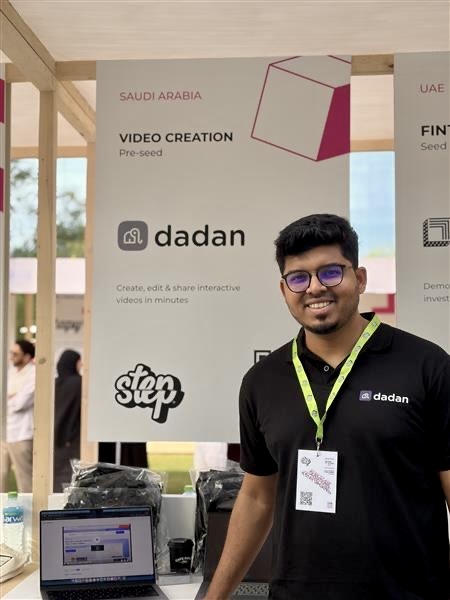
1. Your Booth Branding Is Not a “Small Detail.”
If you send your logo, don’t assume it will be printed the way you envision it. Ask how it will be printed, what background it will sit on, and request a mockup if possible.
We showed up to find an all-black version of our logo printed — a version we never provided — simply because the printing format wasn’t clarified. It sounds minor, but branding inconsistencies at an event subtly affect perception.
Clarity > Assumptions.
2. Booth Location Can Make or Break Your Experience
Always ask where your booth will be placed. If the organizer says placement is “random,” request the full layout in advance.
We were assigned an outdoor booth in the 30°C Dubai heat. Laptops under direct sunlight overheated and shut down. Imagine trying to demo your product while your screen says, “Temperature too high.”
Understanding the layout beforehand allows you to plan shade solutions, backup devices, or even a conversation with the organizer.
3. The Wi-Fi Will Fail You. Prepare Accordingly.
No matter what organizers promise, event Wi-Fi will disappoint you.
Download your demos. Store offline videos. Keep presentation decks locally accessible. Print essential material. Assume you will not have stable internet.
If your demo depends entirely on live connectivity, you’re one network glitch away from losing a conversation.
4. Your One-Liner Should Create Curiosity, Not Clarity
As marketers, we love clarity. At events, clarity can sometimes work against you.
We used a straightforward line: “Record, edit, and share interactive videos in minutes.” It explained everything — and that was the problem. People read it, understood it, and walked away.
A booth headline isn’t meant to fully explain. It’s meant to create a pause. A slight ambiguity invites a question. And a question starts a conversation.
Curiosity converts better than clarity at events.
5. Don’t Fight the AI Buzzwords. Use Them (Smartly).
You may be tired of hearing “AI agents,” “agentic workflows,” and every other buzzword floating around. But your audience — especially investors, mentors, and ecosystem players — is scanning for those signals.
This isn’t the place to resist trends. It’s the place to position within them.
The smarter move isn’t avoiding AI language. It’s actually building something meaningful with it, so your positioning reflects reality rather than hype.
6. Treat Every Conversation Like It Matters — Because It Might.
You never know who you’re speaking to.
One person casually walking around asking questions turned out to be an active investor in the region. Luckily, every conversation was treated with equal attention and respect.
Have your numbers ready. Your user base. Pricing. Unit economics. Top customer logos. Growth metrics. When opportunity appears, you won’t have time to Google your own data.
7. Experiment With Your Pitch — This Is Live Market Research.
Events are the best A/B testing ground you’ll ever get.
Try different opening lines. Change your framing. Observe what triggers follow-up questions and what shuts conversations down. Notice body language. Notice when people lean in.
Instead of rigidly repeating one polished pitch, treat the event as a live lab.
8. Use the Event to Validate (or Redefine) Your ICP
If you meet someone who resembles your Ideal Customer Profile, don’t oversell. Listen.
Ask about their workflow. Their current tools. Their frustrations. How decisions are made internally. These are primary research moments you rarely get in such raw form.
Sometimes, you’ll realize your assumed ICP isn’t actually your ICP. That insight alone can reshape your strategy.
9. Have Your Numbers on Instant Recall
Pricing tiers. Revenue model. Average contract value. Number of active users. Retention rates.
When someone asks, your answer should be immediate and confident. Hesitation signals uncertainty. Precision signals credibility.
Events compress time — you don’t get second chances to “get back with details.”
10. Stop Hunting for Deals. Start Building Recall.
Very few meaningful deals close on the spot.
Your goal isn’t to push for business. It’s to build memorable interactions. Find a shared thread — a football team, a regional insight, a mutual frustration, a joke.
When you receive a visiting card, note something specific about the conversation. Later, when you follow up, reference that shared detail. It shifts you from “another sales email” to “that person I had a good chat with.”
That difference matters.
Final Thought
Conferences aren’t about footfall. They’re about feedback loops.
They test your positioning, your clarity, your preparedness, and your ability to read people.
- If you approach them purely as lead-generation machines, you’ll be disappointed.
- If you approach them as accelerated learning environments with relationship upside, you’ll extract far more value.
- If events are on your 2026 calendar, prepare deeper than your booth design.
You’re not just showing up. You’re being evaluated — by customers, investors, competitors, and sometimes, by your own assumptions.
