



Your team is busy. Your pipeline isn’t.
Picture your Monday marketing standup. Your content lead launched a webinar. Your paid manager tested three new LinkedIn ad creatives. Your SDRs sent 400 cold emails with a fresh hook. Your lifecycle person rewrote the onboarding sequence.
Four people, four experiments, four green checkmarks on the sprint board. Then the quarter closes, and pipeline sits flat.
You’ve seen the 80/20 rule play out in your own dashboards. A small slice of your activity drives most of the revenue, and the rest burns budget and calendar time. Most leaders respond by hunting for the magic 20% and cutting the rest.
I think that diagnosis misses the cause. Your team ran good experiments. They ran them alone. The webinar list never reached the SDRs. The ad test never saw the webinar attendees. The onboarding rewrite never learned which pain points the webinar Q&A surfaced. Each test lived, reported a number, and died in its own lane.
I call the fix experiment stacking.
What is experiment stacking?
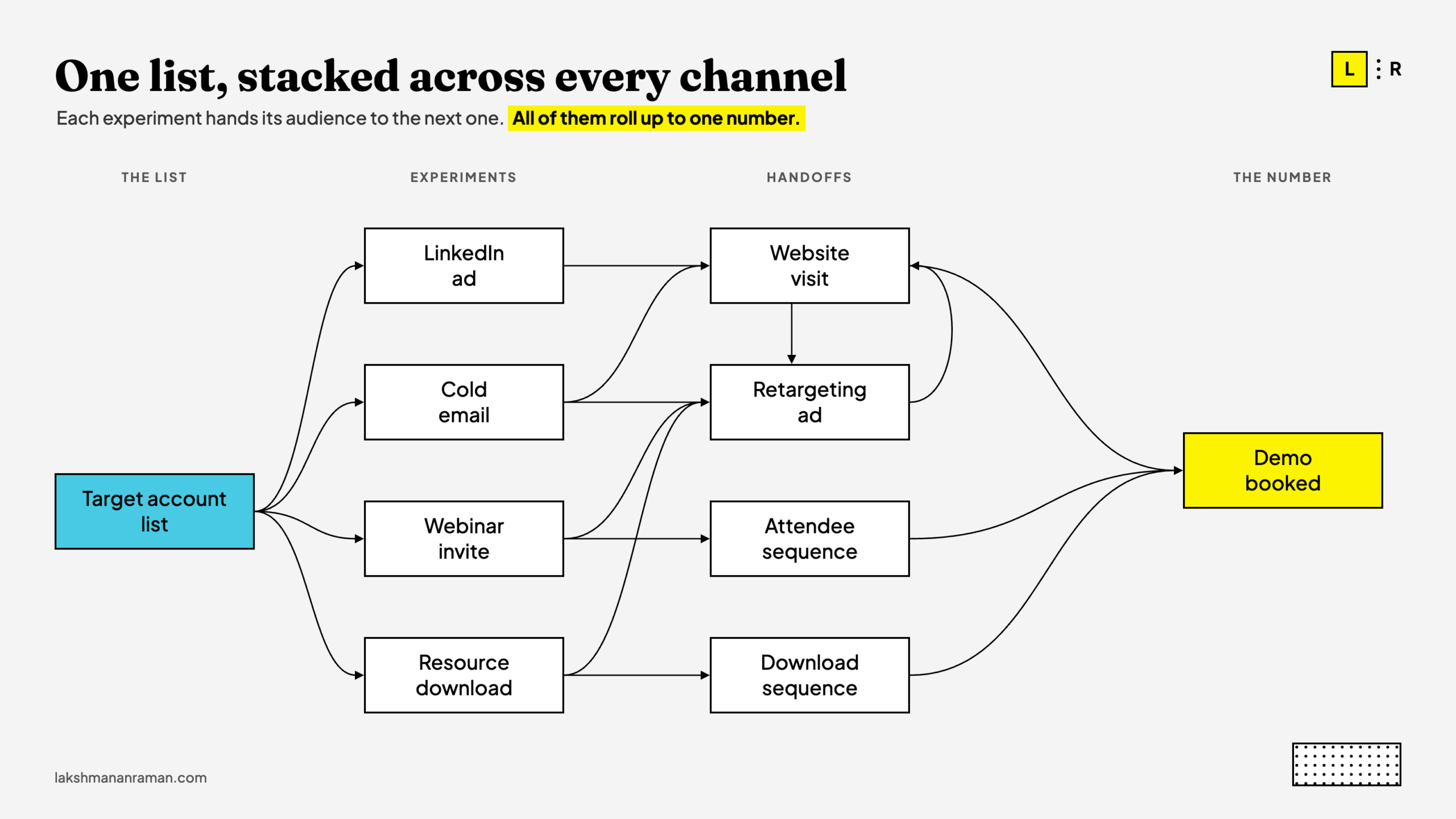
Experiment stacking means you design every marketing experiment so its output becomes an input for another team’s experiment. The audience, the data and the content one test produces get handed to sales, paid, content and lifecycle before the test even ends.
The one-line version: one experiment, many owners.
A siloed experiment asks one question: did this work? A stacked experiment asks two: did this work, and who else on the team can use what it produced?
Two things move between teams in a stack:
- People. Registrants, attendees, clickers, repliers, page visitors. Your SDRs, AEs and paid team can all act on the same list.
- Signals. Which topic pulled registrations, which question came up in Q&A, which objection killed a reply. Your copywriters and product marketers can use those.
The content itself (a recording, a deck, a quote) travels with them as raw material for the next test.
The idea borrows from growth loops. In 2018, Brian Balfour, Casey Winters, Kevin Kwok and Andrew Chen argued at Reforge that the classic funnel splits product, channels and monetization into separate plans and gives each team its own metric. Their answer was a loop: each cycle’s output feeds the next cycle’s input. Experiment stacking applies the same rule to the work your marketing team ships every week.
Why marketing experiments die in silos
Your team doesn’t silo experiments on purpose. Four forces push them there.
1. Every owner reports a different metric
Your webinar owner reports registrations. Your paid manager reports cost per lead. Your SDR lead reports meetings booked. Nobody owns the number that sits between them, so nobody spends a minute connecting them. The Reforge growth-loops essay names this exact failure: teams optimize their own metric, often at another team’s expense.
2. Buyers spend almost no time with you
Gartner’s research on B2B buying found that buyers spend about 17% of the purchase journey meeting potential suppliers. Split across three vendors, you get roughly 5% of their attention (Gartner, 2018). If your webinar earns 45 minutes of a buyer’s focus and your SDR never mentions it, you threw away a large share of the 5% you had.
3. Most of your audience won’t buy this quarter
The LinkedIn B2B Institute’s 95:5 rule, from Peter Weinberg and Jon Lombardo with Ehrenberg-Bass researcher John Dawes, says only about 5% of B2B buyers are in-market at any moment (Marketing Week). A siloed webinar judges itself on the 5% who book a demo this month. A stacked webinar hands the other 95% to paid and lifecycle, who keep your brand in front of them until they’re ready.
4. You kill tests too early
You run a test, check the number, and scrap it if it misses. That habit treats a test as a pass/fail exam. A stacked test gets graded on what it fed downstream: the retargeting audience it built, the SDR reply rate it lifted, the objections it surfaced for the next ad. Plenty of tests that “failed” on their own metric would pass on that second scorecard.
One webinar, stacked five ways
Take the most common B2B experiment: a webinar. Here is how a siloed team runs it, then how a stacked team runs the same event.
The siloed version. Marketing promotes the webinar to its email list. 300 people register, 120 show up. Marketing sends a recording, logs “120 attendees” in the monthly report, and moves on to the next event.
The stacked version. Before the invite goes out, the webinar owner books 30 minutes with each team that touches the same buyers and asks one question: “How can you use this?” The answers turn one event into five experiments.
| Team | What they take from the webinar | Their experiment |
|---|---|---|
| SDRs and AEs | Registrant list matched to open opportunities and target accounts | Invite prospects personally; follow up with a clip that answers their account’s top question |
| Paid media | Registrant and attendee lists uploaded as matched audiences | Retarget no-shows with the recording; retarget attendees with a case study |
| Content | Recording, transcript and live Q&A | Cut 5 to 8 short clips and turn the top questions into posts or blogs |
| Lifecycle / email | Attendance and watch-time data | Branch the follow-up: no-show, watched under 10 minutes, watched to the end |
| Product marketing | Poll answers and Q&A themes | Test the most-asked objection as a headline on the next landing page |
The no-show group matters more than most teams think. ON24’s 2018 benchmarks found that 35% of webinar attendees watched only on demand, after the live session ended (ON24). A siloed team counts those people as lost. A stacked team hands them to paid and lifecycle as a warm audience.
The event costs the same. The team gets five readouts from it instead of one.
How to build an experiment stack: the STACK framework
You can run this in a 45-minute planning meeting before any experiment launches. Each letter is one step.
S: Set one shared number
Pick the one metric every experiment in the stack rolls up to. For most B2B teams that is qualified pipeline created, or sales-accepted opportunities. Registrations, CPL and reply rate stay on the dashboard as diagnostics. They stop being the headline.
Without a shared number, each owner defends their own lane. With one, the webinar owner cares whether the SDR follow-up worked, because both of them answer to the same figure.
T: Tag the outputs before launch
List what the experiment will produce, in two columns:
- People: who will register, click, reply, visit or attend.
- Signals: what you will learn about them (topic interest, objections, timing, account fit).
Write this down before you launch. Once a test ends, the team is already on the next one, and the outputs sit unused in a tool nobody opens.
A: Assign a downstream owner to each output
For every row on that list, name the person who will use it and what they will do with it. Use the webinar table above as the template. An output with no owner gets deleted from the plan, or you find an owner.
This is the step that breaks silos. Your SDR lead, paid manager and content lead each walk out of the meeting with an experiment of their own that depends on yours.
C: Connect the plumbing first
Stacks fail on logistics. Before launch, set up:
- A CRM tag or campaign for everyone the experiment touches.
- Matched audiences in your ad platforms, synced from that tag.
- UTM conventions so every downstream touch traces back to the source experiment.
- One shared doc or Slack channel where each owner posts their result.
If a handoff needs a manual CSV export, assume it won’t happen in week three.
K: Keep score on the stack
Grade the stack as one unit. Review it two to four weeks after launch, when downstream experiments have had time to move. Ask three questions in the review:
- Did the stack move the shared number?
- Which handoff produced the biggest lift?
- Which output went unused, and why?
The answer to the second question tells you what to stack next. The answer to the third tells you where your plumbing leaks.
Experiment stacking vs habit stacking, tiny experiments and skill stacking
You’ll hear three similar-sounding ideas in productivity circles. Each one works at the level of one person. Experiment stacking works at the level of a team.
| Idea | Who it’s for | Core move | Source |
|---|---|---|---|
| Habit stacking | One person | Attach a new habit to one you already do | James Clear, Atomic Habits (summary) |
| Tiny experiments | One person | Swap rigid goals for small, time-boxed personal experiments | Anne-Laure Le Cunff, Tiny Experiments, 2025 |
| Skill stacking | One person | Combine several good-enough skills into a rare mix | Popular career advice |
| Experiment stacking | A GTM team | Design each experiment so its outputs feed other teams’ experiments | This article |
Habit stacking anchors a new action to an old one. Experiment stacking anchors a new experiment to an existing one, across people instead of across your day. If you already run tiny experiments on yourself, experiment stacking is the team version: same appetite for small tests, plus the handoffs.
Five stacks you can steal
The webinar is one base layer. Any experiment that touches buyers can carry a stack. Use these as starting points for your next planning meeting.
Gated report or industry survey
- SDRs: call downloaders from target accounts within 48 hours, opening with one finding from the report.
- Paid: retarget downloaders with a demo offer; retarget page visitors who didn’t download with a single stat from the report.
- Content: turn each chart into a LinkedIn post and each section into a blog.
- PR / partnerships: pitch the headline finding to newsletters in your category.
Founder or exec LinkedIn post
- SDRs: reach out to people from target accounts who commented or reacted, referencing the post.
- Paid: boost the posts that earned the most saves and comments as thought-leader ads.
- Product marketing: read the comments for objections and language buyers use.
New landing page or pricing page test
- Paid: send each ad variant to the matching page variant so you learn message and page together.
- Sales: give AEs the winning headline as a talk track and track whether it shortens discovery calls.
- Lifecycle: reuse the winning value proposition as the subject line in nurture emails.
Cold email sequence
- Content: turn the reply with the best objection into a blog post or FAQ answer.
- Paid: upload the sequence list as an audience so prospects see your ads during the sequence.
- Product marketing: log which hook earned replies and test it as ad copy.
Customer case study
- Sales: add it to the follow-up template for every deal in the same industry.
- Paid: run the customer quote as ad creative against lookalikes of that customer.
- Events: invite the customer onto your next webinar, which starts a new stack.
Mistakes that break a stack
Stacking everything on day one. Start with one base experiment and two downstream owners. A five-team stack on your first try turns the planning meeting into a committee. Add layers once the first handoffs run without reminders.
Handing off lists without context. An SDR who gets 300 names and no note will send the same cold email they always send. Pass the signal with the list: which session they attended, what they asked, how long they watched.
Grading downstream teams on their old metrics. If your paid manager still gets judged on CPL alone, retargeting webinar no-shows looks expensive. Score their piece of the stack on the shared number.
Skipping the review. Without the K step, the stack quietly collapses back into silos within a quarter. Put the review on the calendar when you launch.
Confusing a stack with a campaign calendar. A campaign calendar lines up activities by date. A stack links them by inputs and outputs. You can have a full calendar and zero stacks.
FAQ
What is experiment stacking in marketing?
Experiment stacking is a planning method where every marketing experiment is designed so its outputs (people, signals and content) feed experiments run by other teams, such as sales, paid media and lifecycle. The whole stack is graded on one shared number, usually qualified pipeline.
How is experiment stacking different from habit stacking?
Habit stacking, popularized by James Clear, links a new personal habit to an existing one. Experiment stacking links a new marketing experiment to an existing one across a team, so one effort produces results in several channels.
Is experiment stacking the same as a growth loop?
They share a principle: outputs become inputs. A growth loop describes how a product compounds over time. Experiment stacking is the weekly planning habit that makes your marketing team’s work compound.
How many experiments should I stack at once?
Start with one base experiment and two downstream experiments. Add more once the handoffs run without reminders.
Does experiment stacking work for early-stage startups?
Yes, and small teams have an advantage. When one person runs content, paid and outbound, the handoffs happen inside one head. Write the STACK plan down anyway so you remember to use each output.
What tools do I need?
A CRM that can tag contacts by campaign, an ad platform that accepts matched audiences, UTM tracking and a shared doc for results. You don’t need new software.
Start with your next experiment
You don’t need a reorg to fix siloed marketing. Look at the next experiment on your board, whatever it is, and book 30 minutes with two people outside its lane. Ask them how they’d use what it produces. Write down their answers, wire up the tags, and put a review on the calendar.
Your team will run the same number of experiments next quarter. The difference is how many of them talk to each other.
I write Execution Log every week: one thing I tried, one thing I learned, one thing that failed, from building GTM for SaaS products. Subscribe here to get the next one.
Sources
- Balfour, Winters, Kwok and Chen, Growth Loops are the New Funnels, Reforge, July 2018
- Gartner, How B2B Sales Reps Maximize Customer Interactions, August 2018
- Weinberg and Lombardo, The 95:5 rule is the new 60:40 rule, Marketing Week
- ON24, 2018 Webinar Benchmarks Report
- Shortform, What Is Habit Stacking?
- Penguin Random House, Tiny Experiments by Anne-Laure Le Cunff, 2025
